Prorated rent calculator
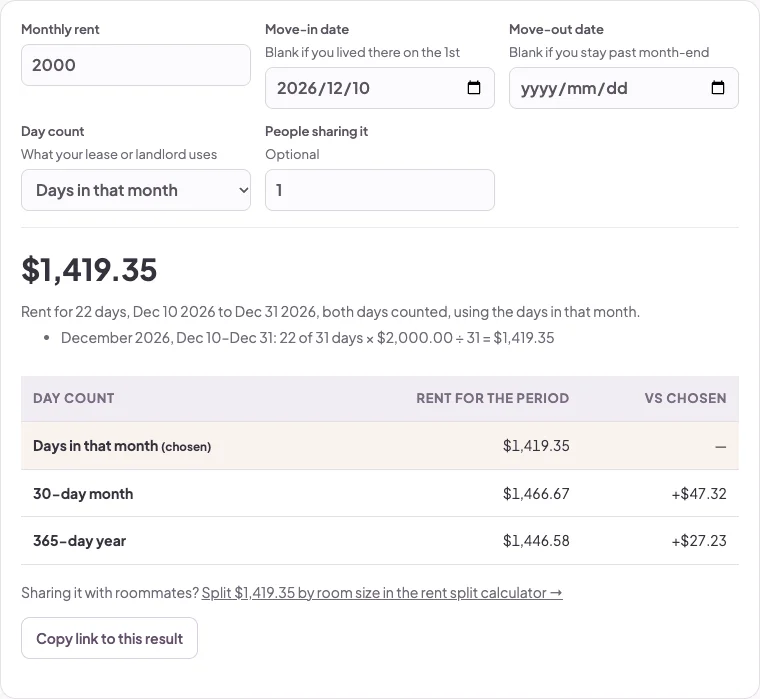
Prorated rent is the monthly rent divided by a number of days, times the days you are charged for. The divisor is where leases differ: the days in that month, a flat 30, or 365 days a year. Moving into a $2,000 apartment on December 10, 2026 (22 days, both ends counted) costs $1,419.35, $1,466.67 or $1,446.58 depending on which one your lease uses.
$1,419.35
Rent for 22 days, Dec 10 2026 to Dec 31 2026, both days counted, using the days in that month.
- December 2026, Dec 10–Dec 31: 22 of 31 days × $2,000.00 ÷ 31 = $1,419.35
| Day count | Rent for the period | vs chosen |
|---|---|---|
| Days in that month (chosen) | $1,419.35 | — |
| 30-day month | $1,466.67 | +$47.32 |
| 365-day year | $1,446.58 | +$27.23 |
Sharing it with roommates? Split $1,419.35 by room size in the rent split calculator →
Enter a move-in date, a move-out date or both. Both days are counted as days you pay for. A month you live in from the 1st to the last day is charged in full whatever the method. The calculator runs in your browser; nothing is sent anywhere.
How to calculate prorated rent
- Daily rate. Monthly rent ÷ days in that month, ÷ 30, or × 12 ÷ 365 (366 in a leap year).
- Days you owe. Count the move-in day and the move-out day. December 10 to 31 is 22 days, not 31 − 10 = 21.
- Multiply, then round once. Daily rate × days, rounded to the cent at the end. A part-month never costs more than the full month.
For $2,000 rent the daily rate is $71.43 in February 2026, $64.52 in any 31-day month and $66.67 in a 30-day month under the first method; $66.67 every month under the 30-day method; and $65.75 every month under the 365-day method.
2026, month by month: moving in on the 15th
The same $2,000 rent and the same move-in day give different amounts in different months, and the three methods disagree by up to $79.45:
| Move in on the 15th of | Days owed | By days in month | 30-day month | 365-day year |
|---|---|---|---|---|
| January | 17 | $1,096.77 | $1,133.33 | $1,117.81 |
| February | 14 | $1,000.00 | $933.33 | $920.55 |
| March | 17 | $1,096.77 | $1,133.33 | $1,117.81 |
| April | 16 | $1,066.67 | $1,066.67 | $1,052.05 |
| May | 17 | $1,096.77 | $1,133.33 | $1,117.81 |
| June | 16 | $1,066.67 | $1,066.67 | $1,052.05 |
| July | 17 | $1,096.77 | $1,133.33 | $1,117.81 |
| August | 17 | $1,096.77 | $1,133.33 | $1,117.81 |
| September | 16 | $1,066.67 | $1,066.67 | $1,052.05 |
| October | 17 | $1,096.77 | $1,133.33 | $1,117.81 |
| November | 16 | $1,066.67 | $1,066.67 | $1,052.05 |
| December | 17 | $1,096.77 | $1,133.33 | $1,117.81 |
- 31-day months (January, March, May, July, August, October, December): 17 days. Dividing by 30 charges $36.56 more than dividing by 31.
- 30-day months: the first two methods agree ($1,066.67); the 365-day year is $14.62 lower.
- February is the outlier: 14 days owed out of 28. Using the days in the month gives $1,000.00, exactly half the rent, while the 30-day month gives $933.33 and the 365-day year $920.55.
Open this example in the calculator →
Moving out: the 30-day month can charge a full month for 30 days
The California Department of Transportation’s instructions for its own rentals say a part-month cannot cost more than the monthly rent. Under a 30-day month that cap matters at the end of a 31-day month: moving out on March 30 is 30 days, which is the whole $2,000 under that method ($2,000.00), against $1,935.48 by days in the month. In February it runs the other way: leaving on February 27 costs $1,800.00 under the 30-day month and $1,928.57 by days in the month.
Round at the end: a slip in an official worked example
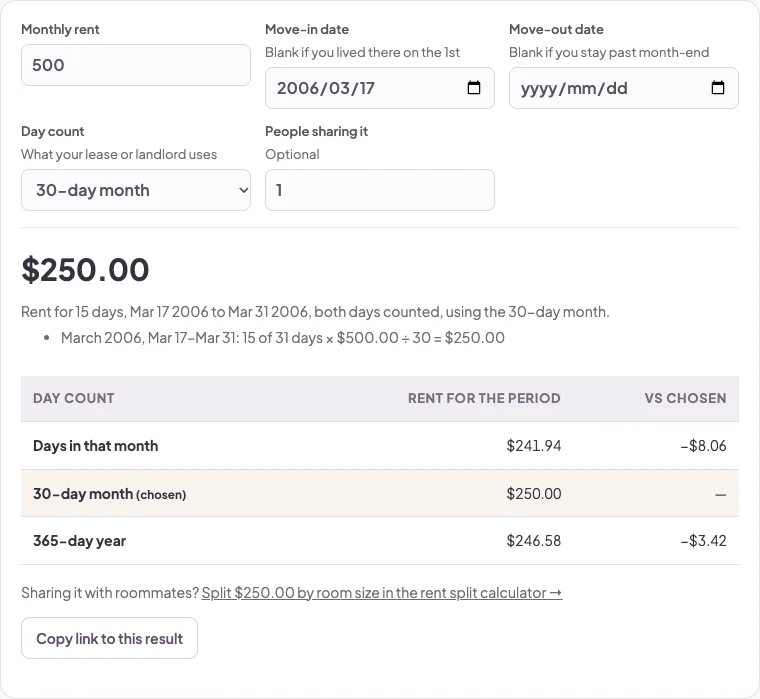
Caltrans exhibit 11-EX-5 (revised January 2020) prorates $500 rent on a 30-day month. Its step 1 says to work out the daily rate and “Do not round at this point”, then to round the result to the nearest penny. Its worked examples, though, multiply the rounded rate of $16.67, so each prints a few cents more than its own rule gives:
| Example | Days | Exhibit prints | Rounded at the end | Difference |
|---|---|---|---|---|
| March 17 move-in (March has 31 days) | 15 | $250.05 | $250.00 | +$0.05 |
| June 23 move-in | 8 | $133.36 | $133.33 | +$0.03 |
| February 25 move-in (28 days) | 4 | $66.68 | $66.67 | +$0.01 |
| February 27 move-out | 27 | $450.09 | $450.00 | +$0.09 |
The printed amounts are exactly what rounding first gives ($250.05, $133.36, $66.68, $450.09). A few cents is small, but the same slip on a $2,000 rent, rounding $2,000 ÷ 31 to $64.52 before multiplying by 30 days, gives $1,935.60 instead of $1,935.48. The calculator keeps the full rate and rounds once.
Open this example in the calculator →
Counting the days
Both the move-in day and the move-out day are days in the home, and the Caltrans exhibit counts both. Counting December 10 to 31 as 31 − 10 = 21 days instead of 22 under-charges by $64.51 on $2,000 rent ($1,354.84 instead of $1,419.35). If your lease says the tenancy starts on a date, that date is day one.
Prorating between roommates
A landlord prorates the whole rent; roommates usually prorate a room’s share. In the four-methods flat Casey’s 100 sq ft room pays $823.41 a month. If Casey moves in on December 10, 2026 and the room was empty before, Casey owes $584.36 by days in the month ($603.83 on a 30-day month). The landlord still expects the full rent for December, so the household has to agree who covers the other $239.05 of that room for December 1–9: the two who were already there, or whoever left the room. Three ways to settle a gap between roommates are worked out in our prorated rent guide.
Enter a room’s share instead of the whole rent to prorate one person, or set “People sharing it” to split a prorated rent equally. For rooms of different sizes, the link under the result opens the rent split calculator with the prorated amount as the rent.
Which day count applies?
| If your lease… | Use | Note |
|---|---|---|
| gives a daily rate or says “per diem” | That rate × days | Nothing to choose. |
| says rent is prorated “based on the number of days in the month” | Days in that month | February costs more per day than March. |
| says “based on a 30-day month” | 30-day month | Check the cap: a part-month should not exceed one month’s rent. |
| gives an annual rent or says “365-day year” | 365-day year | Daily rate = annual rent ÷ 365 (366 in a leap year). |
| says nothing | Ask, and agree in writing | Whether a landlord must prorate at all depends on the lease and state law; see what we found for California. |
Sources and method
- California Department of Transportation, Right of Way Manual exhibit 11-EX-5, Rent Proration Examples (rev. 1/2020), read 14 November 2026: 30-day month, move-in and vacate days counted, cap at the monthly rent, and the printed example amounts quoted above.
- Zillow, Prorated Rent Calculator, read 14 November 2026: divides by the number of days in the month (its example uses 30).
- Daily rates and amounts: the arithmetic stated in the text, computed with the calculator’s own code, the same code that runs on this page.
- Every Sharebirch amount on this page comes from the calculator’s own code; open an example to repeat it.
Next steps
- What prorated rent means and when a landlord has to prorate.
- Rent split calculator: split the prorated rent by room size.
- Roommate agreement template: write down how move-ins and move-outs are prorated.