Split bills based on income: calculator and three methods compared
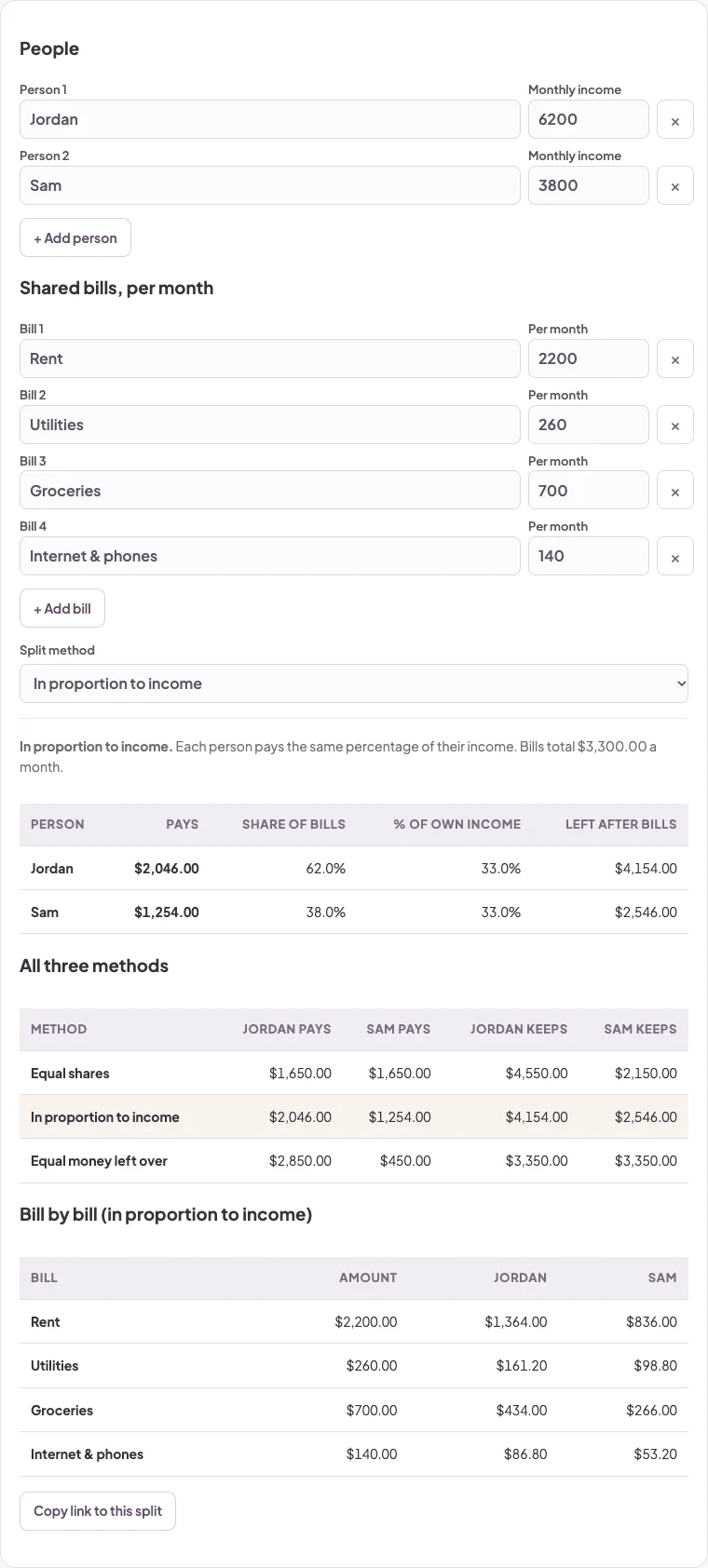
To split bills based on income, each person pays the bills times their share of the combined income. Jordan takes home $6,200 a month and Sam $3,800, so Jordan earns 62% and pays $2,046.00 of their $3,300.00 in shared bills; Sam pays $1,254.00. Both then spend 33.0% of their income on shared bills. Splitting 50/50 instead would cost Sam 43.4% of theirs.
People
Shared bills, per month
In proportion to income. Each person pays the same percentage of their income. Bills total $3,300.00 a month.
| Person | Pays | Share of bills | % of own income | Left after bills |
|---|---|---|---|---|
| Jordan | $2,046.00 | 62.0% | 33.0% | $4,154.00 |
| Sam | $1,254.00 | 38.0% | 33.0% | $2,546.00 |
All three methods
| Method | Jordan pays | Sam pays | Jordan keeps | Sam keeps |
|---|---|---|---|---|
| Equal shares | $1,650.00 | $1,650.00 | $4,550.00 | $2,150.00 |
| In proportion to income | $2,046.00 | $1,254.00 | $4,154.00 | $2,546.00 |
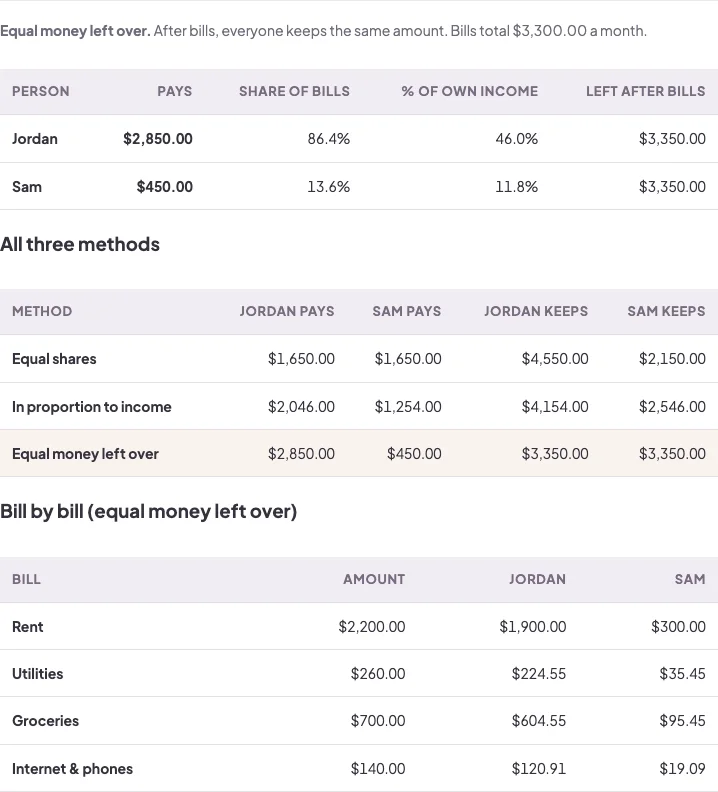
| Equal money left over | $2,850.00 | $450.00 | $3,350.00 | $3,350.00 |
Bill by bill (in proportion to income)
| Bill | Amount | Jordan | Sam |
|---|---|---|---|
| Rent | $2,200.00 | $1,364.00 | $836.00 |
| Utilities | $260.00 | $161.20 | $98.80 |
| Groceries | $700.00 | $434.00 | $266.00 |
| Internet & phones | $140.00 | $86.80 | $53.20 |
Use the same kind of income for everyone: all take-home pay or all gross pay. Up to 6 people and 12 bills; the figures stay in your browser, and the share link carries them after the # sign.
Open this example in the calculator →
Three ways, one couple
| Method | Rule | Jordan pays | Sam pays | Jordan keeps | Sam keeps |
|---|---|---|---|---|---|
| Equal shares | Everyone pays the same amount. | $1,650.00 | $1,650.00 | $4,550.00 | $2,150.00 |
| In proportion to income | Each person pays the same percentage of their income. | $2,046.00 | $1,254.00 | $4,154.00 | $2,546.00 |
| Equal money left over | After bills, everyone keeps the same amount. | $2,850.00 | $450.00 | $3,350.00 | $3,350.00 |
- Equal shares ($1,650.00 each) is simple, but Sam spends 43.4% of their income on shared bills and Jordan 26.6%.
- In proportion to income is what the Fair Share Calculator and Halfway’s calculator do: everyone spends the same percentage, here 33.0%. Jordan still keeps more ($4,154.00 against $2,546.00).
- Equal money left over makes what each person keeps the same: (combined income − bills) ÷ 2 = $3,350.00 each. Jordan pays $2,850.00 and Sam $450.00. It treats the two incomes as one household budget, so it fits couples who pool money; if the gap is wide enough, the higher earner pays everything.
How the gap between incomes moves each method
Same $3,300.00 of bills; what the lower earner pays as the split of combined income moves away from even:
| Income split (higher / lower) | Equal shares | In proportion | Equal money left over |
|---|---|---|---|
| 50% / 50% | $1,650.00 | $1,650.00 | $1,650.00 |
| 55% / 45% | $1,650.00 | $1,485.00 | $1,150.00 |
| 60% / 40% | $1,650.00 | $1,320.00 | $650.00 |
| 70% / 30% | $1,650.00 | $990.00 | $0.00 |
| 80% / 20% | $1,650.00 | $660.00 | $0.00 |
Equal shares never move. Proportional moves $330.00 per 10 points of income share (10% of the bills). Equal money left over moves by half the change in the gap between the two incomes, so with $10,000 of combined income it moves $1,000 per 10 points, and the lower earner pays nothing once the higher earner earns at least the whole bill ($3,300.00) more than they do.
Open this example in the calculator →
Gross or take-home pay?
The two can give different splits, because tax and deductions take different shares of different salaries. Suppose Jordan’s gross pay were $7,900 a month and Sam’s $4,600 (figures for illustration). By gross pay Jordan’s share is 63.2%, so Jordan pays $2,085.60 instead of $2,046.00. Neither is wrong; what matters is using the same kind of figure for both people and noting which one you chose. Take-home pay is closer to the money actually available for bills.
Which bills to include
- In: costs you both use and both pay for: rent or mortgage, utilities, groceries for the home, internet, shared subscriptions.
- Out: each person’s own spending (own phone, own debts, own hobbies), unless you agree otherwise. Keeping them out is what lets the shares stay comparable.
- Itemise: the bill-by-bill table shows each person’s part of every bill, which helps when different people pay different bills and you settle the difference.
Roommates rather than a couple
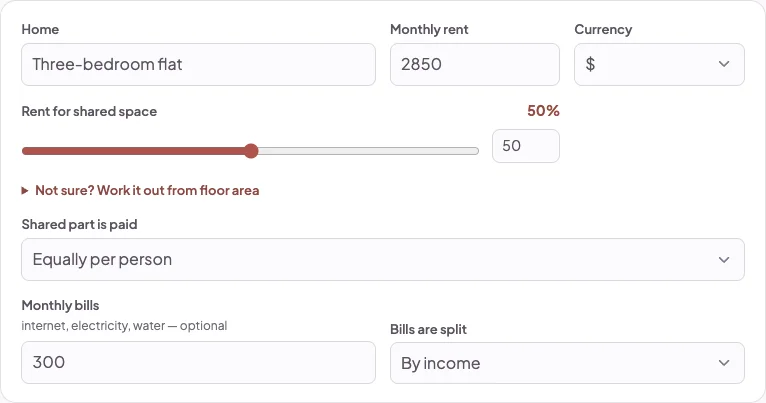
Roommates usually pay rent by room and split only the bills. The rent split calculator now does both: rent by room size, and bills by income. In the $2,850 flat with $300 of monthly bills split by income ($6,000, $4,500 and $3,500), the bills come to $128.57, $96.43, $75.00.
Open this example in the calculator →
Choosing
| If… | Method |
|---|---|
| Incomes are close, or you keep finances fully separate | Equal shares |
| You want everyone to give up the same percentage of income | In proportion to income |
| You pool money and want the same spending money each | Equal money left over |
| You cannot agree | Run all three and agree a figure between two of them |
Sources and method
- All amounts: the arithmetic stated in the text, computed with the calculators’ own code. Incomes and bills are an example, not survey data.
- Fair Share Calculator and Halfway’s Fair Split calculator, read 14 November 2026: both split two incomes proportionally (Halfway also has a custom ratio).
- Every Sharebirch amount on this page comes from the calculator’s own code; open an example to repeat it.
Next steps
- Rent split calculator: rent by room size, bills by income.
- Splitting with a couple and a single: when a couple shares a flat with a third person.
- Roommate agreement template: write the bills method down.